Nairobi Nyama Chai Stall Cash Math Favors Morning Goat Over Evening Kuku Choma
The guidebook Nairobi is a myth. Open any travel site and you'll read that nyama choma—grilled meat—is an evening ritual, best enjoyed with a cold Tusker as the sun sets over the city. That advice might work for a tourist willing to pay 1,500 KES for a plate of chicken, but it misses the entire morning economy where goat ribs cost 100 KES and the meat is still warm from the slaughterhouse. I spent three weeks eating across Nairobi's stalls, tracking prices, watching how locals choose their vendors, and learning why the 6 a.m. queue at Dagoretti Corner is the smartest move a traveler can make.
Why the Guidebook Nairobi Is a Myth
Lonely Planet and similar sources describe nyama choma as a relaxed evening meal, often at upscale joints like Carnivore or Alan Bobbe's. That framing is not wrong for a certain kind of traveler—one who wants table service, a beer menu, and predictable quality. But it completely ignores the pre-dawn market that feeds most of the city's working class. At Dagoretti Corner, the real nyama choma action starts around 5:30 a.m. and is mostly sold out by 9 a.m. The evening version is a different product: often frozen chicken reheated on charcoal, sold at double the morning price.
Guidebooks also miss the social dynamic. Morning meat queues are local affairs—taxi drivers, market workers, and early commuters grabbing a quick breakfast. The atmosphere is efficient, not leisurely. You eat standing, pay in cash, and leave. There is no pressure to order more than you want. In the evening, the same stalls that sell goat ribs at dawn pivot to chicken for the tourist crowd, and the prices shift accordingly. The traveler who arrives at 8 p.m. thinking they'll get the authentic nyama choma experience is actually getting a diluted, inflated version of what the city eats at sunrise.
This is not to say evening nyama choma is always bad. Some established spots like the restaurant at Kilima Camp near the Maasai Mara serve consistent quality. But for the budget-conscious traveler who wants real local food, the guidebook advice is misleading. The best meat, the best prices, and the best cultural insight happen before most tourists have finished their coffee.
The Cash-Only Morning Economy of Dagoretti Corner
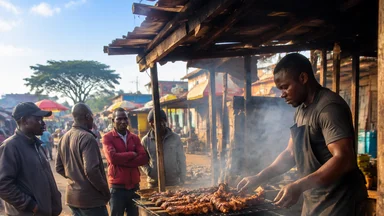
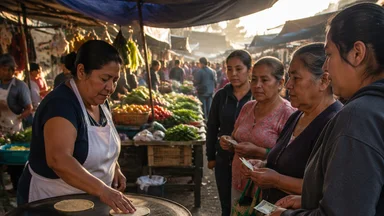
Dagoretti Corner is a sprawling market junction in western Nairobi, best known for its meat stalls that set up before dawn. By 5:30 a.m., the charcoal fires are lit, and the goat carcasses are being portioned on wooden blocks. There are no printed menus; prices are scrawled on cardboard or simply shouted. Goat offal (matumbo) costs around 50 KES per skewer, while prime ribs go for 100 KES. These prices are not fixed—regulars pay 20 to 30 percent less than first-timers, and the ability to speak a few words of Swahili helps.
M-Pesa stalls are everywhere in Nairobi, but the meat sellers at Dagoretti prefer cash. Some accept mobile money, but they add a 10 percent surcharge to cover the transaction fee. That means a 100 KES skewer becomes 110 KES if you tap your phone. The difference is small, but it adds up over a meal. More importantly, cash gives you leverage. Vendors are more willing to negotiate on price or portion size when they see physical notes. One vendor told me, “M-Pesa is fine, but cash is faster. I don't wait for the beep.”
The morning economy is ruthlessly efficient. Goat meat arrives from the slaughterhouse around 4 a.m., and by 6 a.m. the best cuts are gone. If you show up at 9 a.m., you will find only chicken and maybe some tough offal. The stalls do not restock; they sell what they have and close. This is not a supply problem—it is a deliberate model. Vendors buy a fixed amount of meat each morning, knowing they will sell out. It keeps the product fresh and avoids waste. For the traveler, the lesson is clear: set an alarm.
One morning I watched a woman buy five skewers of goat ribs for 400 KES. She was a regular, and the vendor recognized her. When I asked for the same, the vendor quoted 500 KES. I did not argue; I paid, and the meat was excellent. But the price gap was a reminder that this market operates on relationships, not posted rates. The best way to narrow that gap is to show up consistently, even if only for a few days. Vendors remember faces, and a friendly greeting in Swahili goes a long way.
Hygiene Cues Locals Trust (Not the White Towel Test)
Travel blogs often advise checking for clean towels or white aprons as a hygiene indicator. In Nairobi's morning meat markets, that advice is useless. Most vendors wear whatever they arrived in, and the only towel in sight is for wiping hands. Locals use a different set of cues, and they are worth learning. The first is the knife. A shared blade that is not wiped between cuts is a red flag. Good vendors rinse their knives in hot water or wipe them with a clean cloth after each carcass. Watch for that.
Second, smoke volume and smell. Charcoal from acacia wood burns clean and produces a faint, sweet smoke. Cheap charcoal or scrap wood creates thick, acrid smoke that can taint the meat. Locals avoid stalls where the smoke stings the eyes. The smoke should be light and steady, not a billowing cloud. One vendor at Dagoretti explained, “Acacia costs more, but the meat tastes better. You can tell the difference.”
Third, flies. A few flies are inevitable in an open-air market. But a cloud of flies on the meat means the stall is not rotating stock fast enough. Locals check the chopping board: if it is wet with blood and meat scraps, the stall is busy and fresh. A dry board means the meat has been sitting. Color is also key. Bright red meat indicates a recent kill; darker, brownish meat is older. At the morning stalls, the goat is almost always bright red because it was slaughtered hours earlier.
One more cue: the presence of cats or dogs. This sounds counterintuitive, but a few stray animals around a stall is actually a good sign. It means scraps are being tossed regularly, which indicates high turnover. A stall with no animals may be too slow to attract them. Obviously, you do not want animals near the food, but in the chaotic ecosystem of Dagoretti, their presence is a proxy for freshness. Use your judgment.
Evening Kuku Choma: The Trap for Unwary Travelers
Evening kuku choma is the default recommendation for tourists who want a safe, social dinner. But the economics are stacked against the customer. At popular spots like Carnivore or the roadside stalls near Westlands, a portion of chicken costs 1,500 KES or more. The chicken is often frozen, thawed, and reheated on charcoal. The marinade—often a sweet soy-based sauce—masks any off-flavors. One traveler I met reported a bill of 2,000 KES for two skewers and a soda at a stall near a nightclub. The meat was dry and tough.
The price inflation is not random. Evening stalls pay higher rent for their locations near bars and clubs. They also cater to a crowd that is less price-sensitive. A group of friends out for the night will order multiple rounds of meat and drinks without scrutinizing the bill. Vendors know this. One told me, “Daytime customers are workers. They count every shilling. Nighttime customers are spending someone else's money.” The result is a two-tier system: morning goat for locals, evening chicken for tourists.
There are exceptions. Some long-standing evening spots like the stall run by Mama Grace at Gikomba market have fixed prices and consistent quality. But they are rare. The majority of evening stalls operate on a variable pricing model: the first customer pays one price, the last pays another. If you arrive late and look tired, you will be quoted a higher rate. The only defense is to ask the price before ordering and to walk away if it seems high. But even then, the meat quality may not match the morning standard.
I do not want to demonize all evening kuku choma. Some travelers enjoy the atmosphere, the music, and the social scene. That is valid. But if your priority is good meat at a fair price, the evening is the wrong time to eat chicken in Nairobi. The same money that buys two skewers of mediocre chicken at night will buy a full plate of goat ribs in the morning, with leftovers. The choice is simple.
Where the Real Goat Action Is: Three Unlisted Stalls
Mama Njoki's stall operates under a blue tarp near the Kikuyu bus stop, about a 15-minute walk from Dagoretti Corner. There is no sign, no social media presence, and no menu. She opens at 5:30 a.m. and closes when the meat runs out, usually around 8 a.m. Her specialty is goat ribs, grilled over acacia charcoal and served with a side of raw onion and chili. The price: 100 KES for two ribs. The meat is tender, smoky, and still warm from the fire. She does not take M-Pesa, so bring small notes.
Baba Kevin's stall at Kangemi market is about 10 minutes north of Dagoretti by matatu. He specializes in mutura, a traditional Kenyan sausage made from goat offal and blood, stuffed into the large intestine and grilled. The texture is soft and crumbly, with a rich, iron-like flavor from the blood, balanced by the smokiness from the charcoal. A generous portion costs around 100 KES. Baba Kevin is known for his spicy tomato sauce, which he makes fresh each morning. He opens at 6 a.m. and is usually sold out by 9 a.m. No signage, just a grill and a line of regulars.
The third stall is run by a young man named Joseph at the Gikomba market, near the clothing section. He sells goat head (mutura variant) and ribs. His stall is smaller than the others, but the meat is consistently good. He prices ribs at 80 KES, slightly cheaper than elsewhere, because he buys direct from the slaughterhouse. Joseph is friendly and speaks some English. He told me, “I don't need a sign. My customers know where I am.” That is the ethos of Nairobi's morning meat economy: no advertising, no frills, just good meat at a fair price.
Payment Realities: Cash Is King
M-Pesa is ubiquitous in Nairobi, but at the morning meat stalls, cash still rules. About 80 percent of stalls accept M-Pesa, but many add a 10 percent surcharge to cover the transaction fee. That turns a 100 KES skewer into 110 KES. Over a full meal, the surcharge adds up. Cash avoids the fee and often gets you a better price. Vendors are more willing to round down or add an extra piece when they see physical notes.
Credit cards are useless in this context. There is no terminal within 2 kilometers of Dagoretti Corner, and even if there were, the vendors would not accept it. The transaction costs and settlement delays make cards impractical for micro-transactions. Travelers should plan to pay cash for all street food. ATMs in Nairobi dispense 1,000 KES notes, which is too large for a 50 KES skewer. Break a 1,000 KES note at a shop or supermarket before heading to the stalls. Small change is gold.
One strategy: carry a mix of 50, 100, and 200 KES notes. Vendors often cannot make change for a 500 KES note, especially early in the morning when they have not collected much revenue. I learned this the hard way when I tried to pay for a 100 KES skewer with a 500 KES note. The vendor looked at me and said, “No change. Go buy water first.” I walked to a nearby kiosk, bought a 50 KES bottle of water, and returned with 450 KES in small notes. The vendor was happy, and I got my skewer.
For travelers who prefer mobile payments, M-Pesa is still a viable option if you accept the surcharge. The convenience of not carrying cash may be worth the extra 10 percent. But be aware that network congestion can slow transactions, especially in crowded markets. I waited nearly five minutes for one M-Pesa confirmation while the vendor tapped his foot. Cash is faster, simpler, and cheaper. That is the reality.
The One Rule That Overrides Everything: Go Before 8 a.m.
Every piece of advice in this article converges on one rule: go before 8 a.m. The meat is freshest, the prices are lowest, the crowds are local, and the vendors are relaxed. After 8 a.m., the good goat is gone, and only chicken remains. By 9 a.m., the stalls are packing up. The window is narrow, but it is worth the early alarm. I met a traveler who slept through his first two mornings and ended up eating overpriced chicken at a club. He regretted it.
There is a trade-off. The morning stalls are not comfortable. You eat standing, often in the dust, surrounded by the noise of traffic and market activity. There are no chairs, no tables, and no restrooms. If you need a sit-down meal with a cold beer, the evening is better. But if you value food quality and authenticity over comfort, the morning is unmatched. The choice depends on your priorities as a traveler.
The morning crowd is a revelation. You will see taxi drivers, market sellers, construction workers, and a few early-rising tourists. The atmosphere is purposeful but friendly. Vendors have time to chat about the cuts of meat, the charcoal source, and the best way to eat offal. One vendor taught me to dip goat ribs in a mix of chili and salt, then wrap them in a chapati for a portable breakfast. That advice alone was worth the early start.
On my last morning at Dagoretti, a vendor named Peter handed me an extra skewer of goat ribs without my asking. I had been there three mornings in a row, and he recognized me. “You come early, you get good meat,” he said. “You come late, you get chicken.” He laughed, but he was not joking. The morning market is not a secret—it is just invisible to anyone who does not set an alarm. The meat is there, the price is right, and the only thing standing between you and the best nyama choma in Nairobi is a 5 a.m. wake-up call.