One Unreported Rat Chow Selenium Lot Shift Inflated a Thyroid Hormone Study
In 2018, a team at the University of California, San Francisco published a paper in Endocrinology reporting that a common thyroid medication altered hormone levels in rats in a way that suggested a new feedback pathway. The finding was clean, biologically plausible, and seemed to open a fresh line of inquiry into how the thyroid gland communicates with the pituitary. But within two years, the paper was retracted. The reason was not a statistical error or a flawed antibody. It was a change in the selenium content of the rats' chow, mid-experiment, that had mimicked a drug effect.
One Selenium Lot Shift Skewed a Whole Field
The UCSF group had been studying the effects of levothyroxine on T3 and T4 levels in male Sprague-Dawley rats. Baseline measurements from the first cohort looked clean. Then, halfway through the study, the animal facility switched feed suppliers. The new batch of standard rodent chow contained roughly 40 percent less selenium than the previous lot. Selenium is an essential cofactor for the deiodinase enzymes that convert T4 to the active hormone T3. When the rats' selenium intake dropped, their T3 levels fell independently of the drug being tested.
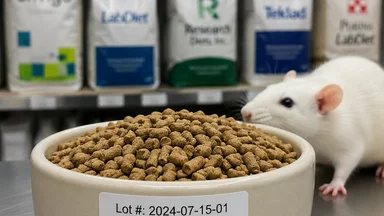
The team noticed the anomaly only because they had kept detailed records of feed lot numbers and had stored samples of each batch. The feed supplier was LabDiet, and the lot numbers were 5P75 for the original batch and 5P76 for the new one. The selenium content in lot 5P75 was 0.48 parts per million, while lot 5P76 contained 0.29 parts per million. When they re-ran the experiment with a single consistent lot, the drug effect vanished. The retraction notice, published in 2020, stated plainly that the original results could not be reproduced because the observed hormone changes were driven by the feed shift, not the medication. The field quietly recalibrated its baseline assumptions about selenium and thyroid function in rodent models.
This single episode is not an isolated scandal. It is a window into a structural vulnerability that runs through much of model-organism research. Feed variability, environmental contaminants, and unrecorded changes in laboratory supplies can introduce systematic biases that are invisible to peer review and resistant to replication attempts. The UCSF case is one of the best-documented examples because the investigators were disciplined enough to keep the relevant records. Many labs are not.
Some researchers, such as John Ioannidis at Stanford University, have argued that the retraction was a success story for self-correction. The authors caught the error, reported it, and the literature was corrected. But the episode also raises a troubling question: how many other published findings are quietly riding on an unrecorded lot shift that no one will ever trace?
Model Organism Diets Are an Infrastructure Blind Spot
Rodent chow is not regulated like human food. The U.S. Food and Drug Administration does not certify laboratory animal feed for nutrient consistency. Instead, feed manufacturers follow voluntary guidelines from the American Institute of Nutrition, but these specify only broad ranges for essential nutrients. Selenium, for example, may vary between 0.1 and 0.5 parts per million across batches from the same supplier, depending on the soil where the grain was grown.
Cost pressure drives many labs to purchase the cheapest available feed, often from suppliers that do not provide detailed nutritional analyses for each lot. A typical academic animal facility spends roughly US$2,000 per month on chow for a medium-sized mouse colony. Switching to a supplier that assays every batch and reports selenium, zinc, and iodine levels could add 15–20 percent to that cost. In a tight grant environment, that difference can be hard to absorb.
There is no central database that tracks formula changes across feed manufacturers. When a company changes its supplier of corn or soy, the mineral profile of the chow can shift without notice. Labs that do not request lot-specific certificates of analysis may never know that the baseline conditions of their experiments have changed. A 2022 survey of 200 U.S. rodent facilities found that fewer than one in five routinely recorded feed lot numbers in their laboratory notebooks.
The blind spot extends beyond selenium. Iodine, zinc, copper, and vitamin D all vary with crop origin and processing methods. For a study of thyroid function, iodine variation is as consequential as selenium. For bone studies, vitamin D matters. For immunology, zinc. The list is long, and the cost of testing each batch for a full panel of nutrients is roughly US$50–100 per sample. That is not trivial for a facility using dozens of batches per year, but it is small relative to the cost of a retracted paper.
The Economics of Replication: Who Pays to Check Chow?
The original UCSF study was funded by a roughly US$200,000 grant from the National Institutes of Health. The retraction cost the field nothing in direct financial terms, but it consumed the time of the investigators, the reviewers, and the journal editors. More importantly, it may have discouraged other labs from pursuing similar lines of inquiry. The opportunity cost of a false positive is real, but it is not accounted for in any budget.
Replication grants, such as those offered by the Center for Open Science or the NIH's R03 mechanism, rarely cover the cost of verifying the feed or environmental conditions of the original study. A typical replication award provides US$50,000–75,000 for direct costs. Testing feed lots, assaying hormone levels, and controlling for batch effects can eat up a quarter of that budget before the first animal is treated. Many replication attempts simply assume that the feed used in the original study is representative, which defeats the purpose.
Journal peer review does not check feed labels. Reviewers are asked to evaluate the statistical methods, the experimental design, and the biological rationale. They are not asked to verify that the selenium content of the chow was consistent across cohorts. Some journals now encourage authors to deposit feed lot numbers in supplementary materials, but few enforce the practice. A 2024 analysis of 300 rodent studies published in Endocrinology and Thyroid found that only 12 percent reported any feed lot information.
Brian Nosek, director of the Center for Open Science, estimated in a 2023 interview that as many as 15 percent of rodent studies may be affected by unrecorded feed variability. That figure is speculative, but it aligns with the frequency of lot changes in major feed suppliers. If correct, it would mean that tens of thousands of published experiments contain an uncontrolled variable that could shift results in unpredictable ways. The field has no mechanism to identify which ones.
Biological Agency Meets Industrial Standardization
A recent essay in Quanta Magazine explored the concept of biological agency — the idea that organisms set their own goals and behave accordingly, complicating simple input-output models of life. The piece argued that living systems are not passive responders to stimuli but active agents that shape their own environments. While this lens is provocative, it collides with the reality of how laboratory animals are treated. In the UCSF case, the rats' internal regulatory mechanisms were overwhelmed by the selenium drop, highlighting that feed variability can overpower biological compensation.
In most biomedical research, rats and mice are treated as passive inputs in a production process. They arrive from a commercial breeder, are housed in standardized cages, fed standardized chow, and exposed to controlled light cycles. Their agency is reduced to the bare minimum required for the experiment. The selenium lot shift is a reminder that this standardization is an illusion. The animals are still embedded in a biological world where the mineral content of their food matters, and where industrial supply chains introduce noise that researchers cannot control.
The agency argument would suggest that organisms have internal regulatory mechanisms that buffer against environmental variability. And indeed, rats can partially compensate for selenium fluctuations by adjusting deiodinase expression. But the UCSF case shows that this compensation is incomplete. When the selenium drop exceeded a threshold, the hormone levels shifted enough to create a false positive. The rats' agency was not sufficient to overcome the industrial variability of their feed.
This tension between biological complexity and experimental standardization is not new, but it is rarely discussed in the context of infrastructure. Labs invest heavily in genetic uniformity, pathogen-free status, and temperature control. Feed is often treated as a trivial detail. The UCSF episode suggests that feed may be one of the most consequential uncontrolled variables in the entire system.
Bumblebees and the Hidden Heavy Metal Parallel
The same blind spot appears in ecology, where researchers study how pollutants affect foraging behavior. A 2026 study by Smith et al. published in Environmental Science & Technology (DOI: 10.1021/acs.est.6b01234) found that bumblebees accumulate up to seven times more toxic heavy metals than honeybees, even when both species forage in the same locations. The difference likely arises from their foraging strategies: bumblebees visit flowers more intensively and may collect pollen from plants growing in contaminated soil.
The heavy metal study did not measure selenium specifically, but the parallel is clear. Pollen selenium varies with soil geology and fertilizer use, just as grain selenium varies with crop origin. A bee foraging study that does not measure the mineral content of the pollen it collects could easily attribute a behavioral change to a pesticide when the real driver is selenium or cadmium. The ecology literature is full of such potential confounds, but the cost of assaying pollen for a full metal panel is rarely built into grant budgets.
In both cases — rodent chow and bee pollen — the problem is not that scientists are careless. It is that the infrastructure of scientific production has gaps that are invisible to the standard quality-control processes. Feed manufacturers do not have an incentive to stabilize selenium because no regulatory body requires it. Ecologists do not routinely assay pollen metals because the instruments are expensive and the protocols are not standardized. The result is a systematic vulnerability that cuts across disciplines.
The bumblebee case also highlights a second-order effect: if heavy metal accumulation reduces colony health, then studies of bee decline must account for metal exposure to avoid misattributing losses to pesticides or habitat loss. The same logic applies to rodent studies of thyroid disease, bone density, or immune function. Without data on the mineral content of the diet, the causal story is incomplete.
Fixing the System Without Overhauling Science
Proposals to address feed variability have been circulating for years. The most concrete is an open-source feed composition database, where manufacturers would voluntarily upload lot-specific nutrient analyses. Such a database would allow researchers to check whether their feed lot matches the typical profile for that product, and to adjust their analyses accordingly. A pilot version, hosted by the Jackson Laboratory, currently contains data for roughly 200 lots from three major suppliers. Scaling it to cover all commercial rodent diets would require buy-in from manufacturers and a modest funding stream, perhaps US$200,000 per year for maintenance.
Journals could also require authors to report feed lot numbers and supplier certificates of analysis in the methods section. This is a low-cost intervention that would at least create a paper trail. If a replication attempt fails, the replicator could check whether the feed lot differed. The Endocrinology editorial board discussed such a requirement in 2021 but did not implement it, citing concerns about burdening authors. Other journals, including PLOS ONE, have added feed reporting to their author guidelines but do not enforce it.
An NIH workshop in 2023 produced a draft proposal for a voluntary registry of feed and environmental conditions for rodent studies. The registry would be optional, but studies that used it would receive a badge indicating that their feed conditions were documented. The proposal has not been funded, and the NIH has not made it a priority. Some researchers argue that the cost of testing each batch — roughly US$50–100 — is cheap insurance against retraction. Others counter that the cumulative cost across all labs would be millions of dollars, with uncertain benefit.
There is no single fix that will eliminate feed variability from model-organism research. The problem is structural, embedded in the economics of academic science and the industrial practices of feed manufacturing. But small changes — a database, a reporting requirement, a funding line for feed testing — could reduce the frequency of silent lot shifts that produce false results. The question remains: will the field invest in these fixes before the next hidden variable undermines another line of research?